uKit Review
I would choose uKit for a familiar small-business job: get a presentable service site online quickly, let the owner change prices and photos without calling a developer, and keep the monthly bill predictable. That narrow brief is where the builder still makes sense in 2026.
It is less convincing when the brief includes a custom application, a large editorial operation, a complicated store, or a future move to another platform. uKit saves time by making many decisions for you. The same decisions become constraints later.
I went back through the current product pages, pricing and knowledge base for this update. The practical question was not whether uKit has a long feature list. It was whether I could hand a site to a busy local operator and expect ordinary updates to stay ordinary.

The Monday-morning brief: who should use uKit?
Picture a photographer, tutor, consultant, repair shop or small clinic with a logo, a folder of decent photos and a list of services. The site needs a homepage, service pages, prices, a portfolio or gallery, contact details and perhaps a modest blog. Hosting, SSL and backups should be somebody else’s problem.
That is uKit’s home ground. The platform combines its visual builder with hosting, responsive designs, domain connection and basic promotion tools. You can start with an industry template rather than an empty canvas. The official catalog currently advertises more than 200 designs, while some landing pages advertise 350-plus designs across 40-plus categories. I would treat the larger number as marketing catalog copy rather than a promise that every design is meaningfully different.
It is a poor fit for a developer who wants control of the whole stack. It is also a questionable foundation for a publication with many contributors, a store with sophisticated inventory and fulfillment rules, or a business that expects to export its site and host it elsewhere later. uKit is a hosted service, not a portable content management system.
Tuesday: getting a credible first version online
The quickest route starts with a template. uKit’s designs arrive with useful business-page structures, not just colors and a hero image. Depending on the template, pages for services, prices, contacts, a portfolio and news may already be present. That reduces blank-page time, although the sample copy still needs a thorough rewrite. Leaving generic template language in place is the fastest way to make a business look generic.
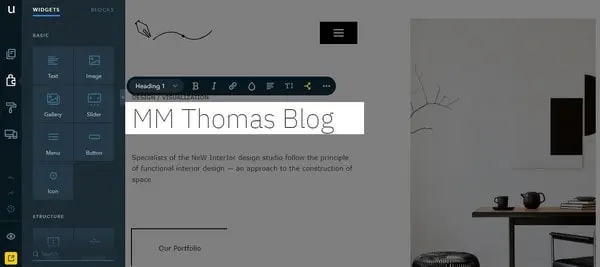
The editor has two main working areas. The Dashboard handles account-level jobs such as domains, statistics, promotion and billing. The Builder is where pages, blocks, widgets and design choices live. On the page, work is largely visual: add a prepared block or widget, replace its content, move it, check the result and publish.
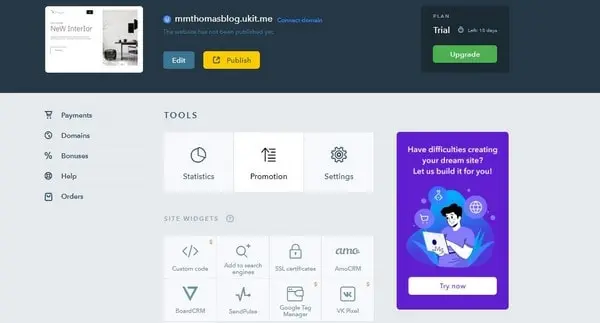
I like this arrangement for a first business site because it gives a beginner boundaries. A price list behaves like a price list. A gallery behaves like a gallery. Contact forms, maps, cards and testimonials can be placed without assembling every detail from scratch. It is quicker than WordPress when WordPress still needs a host, theme, plugins and a maintenance plan.
The trade-off appears as soon as a design calls for something unusual. uKit is based on blocks and widgets, so it does not feel as open-ended as Wix or as design-led as Webflow. Custom HTML, CSS or JavaScript is available on the higher plan according to uKit’s help center, but adding code to a constrained builder is not the same as owning the underlying site.
One useful safeguard is easy to miss. uKit keeps automatic backups and allows up to ten manual backups. I would create one before changing a design or rebuilding a busy page. The company’s documentation notes that Product widget content is not retained in site backups, which matters if the project includes a store.
Wednesday: the owner asks to change prices and photos
This is the part that matters after launch. The owner does not care how pleasant the setup wizard was three months ago. They care whether changing a service price breaks the mobile layout.
For routine edits, uKit is approachable. Text can be edited in place, images can be cropped, and common content such as price lists, cards, galleries and forms has a dedicated widget. Blocks keep spacing and alignment reasonably disciplined. The result is less freedom, but also fewer accidental design disasters.
Templates are responsive, and the builder provides device views plus controls for the mobile and tablet presentation. Individual blocks can be hidden where they would clutter a smaller screen. I would still inspect every important page on a real phone. Automatic adaptation is helpful, not a substitute for checking a long heading, an awkward crop or a form with too many fields.
Changing the overall template is less risky than it is in some builders. uKit says a new design can be applied while preserving the site’s content. I would still make a backup first and expect to review every page afterward. Preserved content does not guarantee preserved emphasis, image crops or spacing.
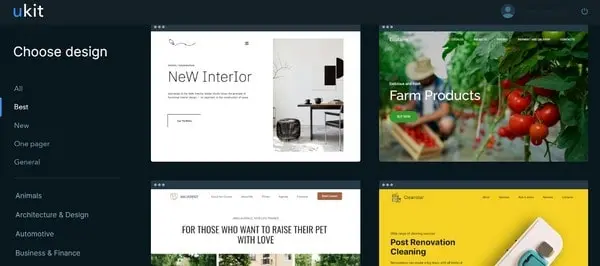
The design library is practical rather than adventurous. Many themes use familiar business patterns, which is an advantage when clarity matters more than novelty. The downside is a recognizable house style. A brand with a strong art direction may reach the limits quickly, while a tradesperson who wants calls and quote requests may never care.
Thursday: leads, analytics and a small shop
A small business site usually earns its keep through enquiries. uKit includes forms and business-oriented widgets, and it can connect to outside services for chat, mailing, analytics and customer management. The precise integration mix changes, so I would confirm any must-have service during the trial rather than relying on an old review.
The native store is more capable than a token payment button. On the eCommerce and Pro plans, uKit documents a product catalog, cart, product options, order forms, shipping methods, payment setup and promo codes. There is no stated product limit in the current store guide. Google Analytics ecommerce tracking can also be enabled.
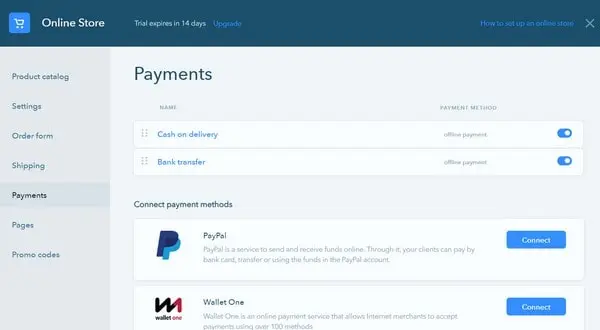
That is enough for a small catalog with straightforward orders. It is not where I would put a fast-growing retail operation that needs advanced inventory, multiple warehouses, a large app ecosystem or detailed automation. For that job, Shopify is the safer specialist. If the business already uses WordPress and accepts its maintenance burden, WooCommerce offers far more control.
There is also an Ecwid widget for businesses that prefer an external commerce layer. The older version of this review treated Ecwid as almost essential. That is no longer a fair description because uKit now documents its own catalog and checkout tools. Ecwid remains an option, not the definition of uKit commerce.
Friday: can customers find the site?
uKit covers the SEO controls expected on a conventional brochure site. Page settings include editable titles, descriptions, URLs and indexing controls. Images can receive title and alt attributes, headings can use H1 through H6, published sites receive a sitemap.xml file, and canonical links can be enabled. Google Search Console and Google Analytics connect from the Dashboard. A promotion checker points out unfinished basics.
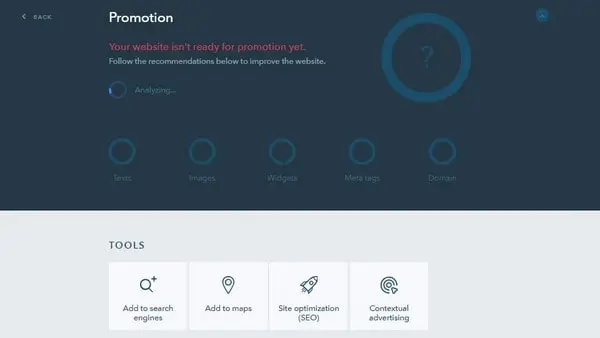
That is a respectable baseline. It does not turn uKit into an SEO platform, and the builder cannot compensate for thin service pages, duplicate local pages or poor photography. Advanced teams may miss deeper schema control, a broader extension market and the technical access available with WordPress or a custom stack.
For a six-page local-business site, I would worry more about accurate contact details, useful service copy, fast images and a well-maintained Google Business Profile. uKit gives the owner enough control to handle the on-page part without installing an SEO plugin.
The AI question in 2026
AI is not the reason to choose uKit. I found no current official product material presenting a generative website, copy or image assistant as a central part of the builder. The Pro pricing card even describes its live chat support as “no AI,” meaning a live operator rather than a bot.
This may suit an owner who wants a conventional template-and-block workflow. Anyone expecting Wix-style conversational site generation or an AI production suite should look elsewhere. I would not count third-party scripts or external writing tools as native uKit features.
What happens when the business outgrows it?
uKit includes sensible ways to work safely inside its own system. You can create backups, restore earlier versions and grant a developer temporary Builder access without sharing the account password. That temporary access excludes billing, domain management and deletion, which is a thoughtful operational detail.
The harder issue is portability. I could not find an official site-export procedure in the current English documentation. Since hosting is part of the service, plan on rebuilding if you later move to WordPress, Webflow or a custom host. Keep original copy, logos and full-resolution images outside uKit. Export any business records that connected services allow. Do not let the website builder become the only copy of company assets.
This lock-in is not unique to uKit, but it deserves more weight than a list of launch features. A cheap site can become expensive if a future migration requires a manual rebuild.
Support when the owner gets stuck
Every plan advertises 24/7 technical support. The Basic plan adds live chat, while Pro advertises priority live chat with a live operator. There is no phone channel listed on the current pricing page.
The knowledge base is broad and task-focused. I found current instructions for templates, blocks, mobile editing, SEO, domains, backups and the store. Some plan descriptions in the help center do not line up perfectly with the main pricing table, however. For example, the custom-code tier is described inconsistently across official pages. When a feature determines the purchase, use the live pricing comparison and ask support to confirm it in writing.
The bill, checked September 16, 2026
uKit has no permanent free plan. There is a 14-day trial, and the site is kept after the trial so it can be upgraded later. At the time of this update, the public pricing page lists four plans:
- Minimal: $9 month to month, or $6.30 per month when paid yearly. It covers the hosted business-site basics, domain attachment, SSL, support and backups.
- Basic: $11 month to month, or $7.70 per month when paid yearly. It adds extended statistics, analytics goals, dynamic text, removal of uKit branding and live chat.
- eCommerce: $13 month to month, or $9.10 per month when paid yearly. It adds the native shop and online payments.
- Pro: $15 month to month, or $10.50 per month when paid yearly. It is the top tier and includes email campaigns plus priority live-operator chat.
Longer prepayment brings larger discounts: 15 percent for three months, 20 percent for six months, 30 percent for a year and 50 percent for two years. Prices, plan boundaries and payment options can change by region or promotion, so check uKit’s live pricing page before paying. I would use the trial first and avoid a two-year commitment until the actual site, required integrations and support route have been tested.
Where uKit saves time, and where it collects the debt
The strongest part of uKit is the short path from business information to a respectable live site. Hosting, SSL, responsive templates, backups and common widgets arrive together. Day-to-day edits are unlikely to intimidate a non-technical owner. The annual price remains low beside the better-known all-in-one builders.
The cost of that convenience is a smaller creative and integration ceiling. There is no permanent free tier, no prominent native AI workflow, no documented full-site export, and no app ecosystem on the scale of Wix or WordPress. The store works for simple selling, but it is not a substitute for a mature commerce platform when operations become complicated.
Three alternatives I would put on the same shortlist
Wix is the broader all-rounder. It offers more design freedom, applications, business tools and AI assistance, but it costs more and presents far more choices. Choose it when the site is likely to expand in several directions.
SITE123 is another fast, guided route for a simple company site. I would compare its current plan limits and multilingual tools directly with uKit during each trial. Both favor speed over deep control.
WordPress is the portability and extensibility choice. It can support almost any publishing or commerce plan and can move between hosts, but somebody must manage hosting, security, updates and plugins. It is not automatically the easier option for a small operator.
My decision after a working week
I would recommend uKit to a solo operator or small company that needs a conventional site quickly and expects to maintain it in-house. The best project is a service site, portfolio, landing page or modest catalog where the standard blocks already match the job.
I would skip it for a content-heavy publication, a complex store, a heavily customized brand experience or any project whose exit plan requires a clean site export. In those cases, the low subscription price hides the more important cost.
uKit remains a credible budget builder because it keeps the routine work short. Pick a design, replace the sample material, connect the domain, check mobile, fill the SEO fields and publish. Just decide before launch whether the business values that speed more than future freedom.


